The Forty-Five Pound Question: Five Budget Airbrush Kits Tried and Judged
The £45 experiment
Budget airbrushing is a bit like buying a second-hand moped: the purchase price is only the opening chapter. I set a hard ceiling of £50 per kit and averaged £45 across five starter sets from a high-street art shop, two UK model retailers, a craft chain and one marketplace listing. Each got a week on the bench: priming 28mm figures, base-coating terrain and a deliberately awkward fine-line test on paper. Where a kit came with a compressor I used it; where it did not, I hooked it to a basic 1/5 hp compressor with a moisture trap. No sponsored samples, no hero paints.
What I marked them on
Spray control came first: could I lay a smooth coat at low pressure, then thin down for a pencil line without spidering? Cleaning effort mattered just as much. A brush that takes twenty minutes to strip after a ten-minute session is not a beginner's friend. I also checked spare-part availability — needles, nozzles and seals — and the real cost of getting started, including thinner, cleaning pot, mask and a compressor if the kit did not include one.
The five shapes of budget kit
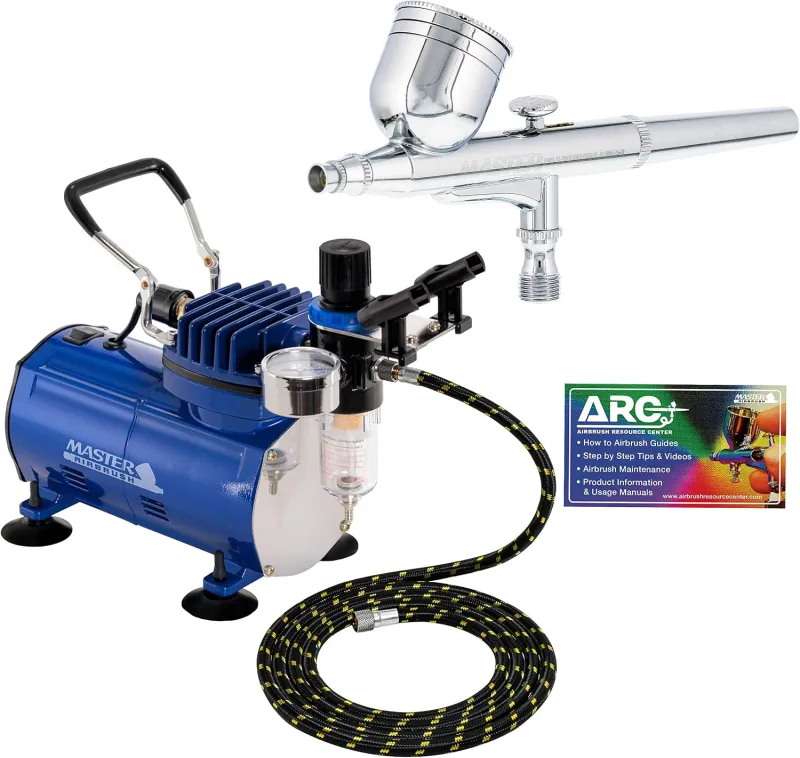
The first was the airbrush-only gravity set, around £30: one 0.3mm brush, a tiny hose and a spanner. The second was the £45 mini compressor combo, with a tankless compressor and a bundled brush. Third came a siphon-feed art-shop kit at £40, the sort that looks serious in a glass cabinet. Fourth was a twin-brush marketplace set at £35, which threw in two brushes, a hose and a lot of hope. Fifth was a compact tankless combo at £48, with a moisture trap and a braided hose.
How they behaved
The airbrush-only gravity set was the surprise. The trigger felt crude, but it atomised well at low pressure and cleaned down to a bare needle in about eight minutes. The 0.3mm nozzle was fine for primer and base coats; fine lines needed thinning and patience. Spares were easy to find because the thread was standard. If you already own a compressor, this is the value pick.
The £45 mini combo was the classic gamble. It sprayed, but the compressor pulsed, the hose was short and the brush had a plasticky feel. Cleaning was fiddly because the nozzle needed a spanner in a tight recess. It is fine for priming toy soldiers and terrain, but not for a beginner who wants to learn control. The tankless compact at £48 was quieter and more stable, with a better moisture trap, but the brush still felt like the weak link.
The siphon-feed art kit was the most disappointing. The bottle was awkward to clean, the trigger had a long throw, and it needed higher pressure to spray craft acrylics. It would suit a school project, not a model bench. The twin-brush marketplace set was better value than expected: two brushes meant one could be kept for primer, but the nozzles were not standard and the instructions were a photocopy of a photocopy. Spares were the problem.
The cleaning test
I timed a full strip-down after a twenty-minute priming session. The gravity-feed brush won comfortably: needle out, nozzle off, a flush through the cup and a wipe of the needle. The mini combo took nearly twice as long because the nozzle needed a spanner and the cup had a narrow neck. The siphon-feed kit was the worst offender. Bottle, lid, tube and nozzle meant four separate cleaning stages, and any dried paint in the tube turned into a morning job. For a beginner, that friction matters more than a fancy trigger.
A note on noise and moisture
If you are airbrushing in a flat or a spare room, noise is part of the value calculation. The £45 mini combo rattled like a small fridge, while the £48 tankless unit was noticeably calmer. Neither came with a proper moisture trap, which is a false economy in a British climate. Add one before you start, or you will be blaming the paint for spluttering that is really condensation.
The real cost
The headline price is not the real cost. Add a cleaning pot, a bottle of airbrush thinner, a proper respirator mask and a moisture trap, and you are £25 to £40 lighter. If the kit has no compressor, add £60 to £100 for something reliable. That is why the £45 average is misleading: the cheapest route is a decent airbrush-only kit plus a compressor you can grow with, not an all-in-one box that leaves no budget for safety.
Verdict
If you have a compressor, buy the £30 gravity-feed brush and spend the rest on spares. If you do not, the £48 tankless combo is the least bad one-box start, but treat the included brush as a placeholder. The £45 gamble is not really about the airbrush. It is about whether you can afford the bits around it. In 2026, the budget end of the market is better than it was, but it still rewards the buyer who reads the spares list before the paint list.